A New, Secular Proof of John Locke’s Natural Rights
A new discovery in the physical universe offers proof, in spite of weaknesses in his basis for them, that John Locke’s natural rights were always real. He correctly saw natural rights as coming out of natural law, as this quote reveals:
“A state also of equality, wherein all power and jurisdiction are reciprocal, no one having more than another; there being nothing more evident than that creatures of the same species and rank, promiscuously born to the same advantages of nature and the use of the same faculties, should also be equal one among another without subordination or subjection…” [Emphasis mine] Second Treatise of Government, Chapter II, Section §4
Locke is talking about capabilities (power) and jurisdiction (right to rule) of operators. This is exactly the Temporal Rights paradigm. If he had been looking for rights for a beaver, he would have discovered the Temporal Rights view of universal natural rights.
Thomas Hobbes
Thomas Hobbes in writing “Of the First and Second Natural Laws, and of Contracts” wrote:
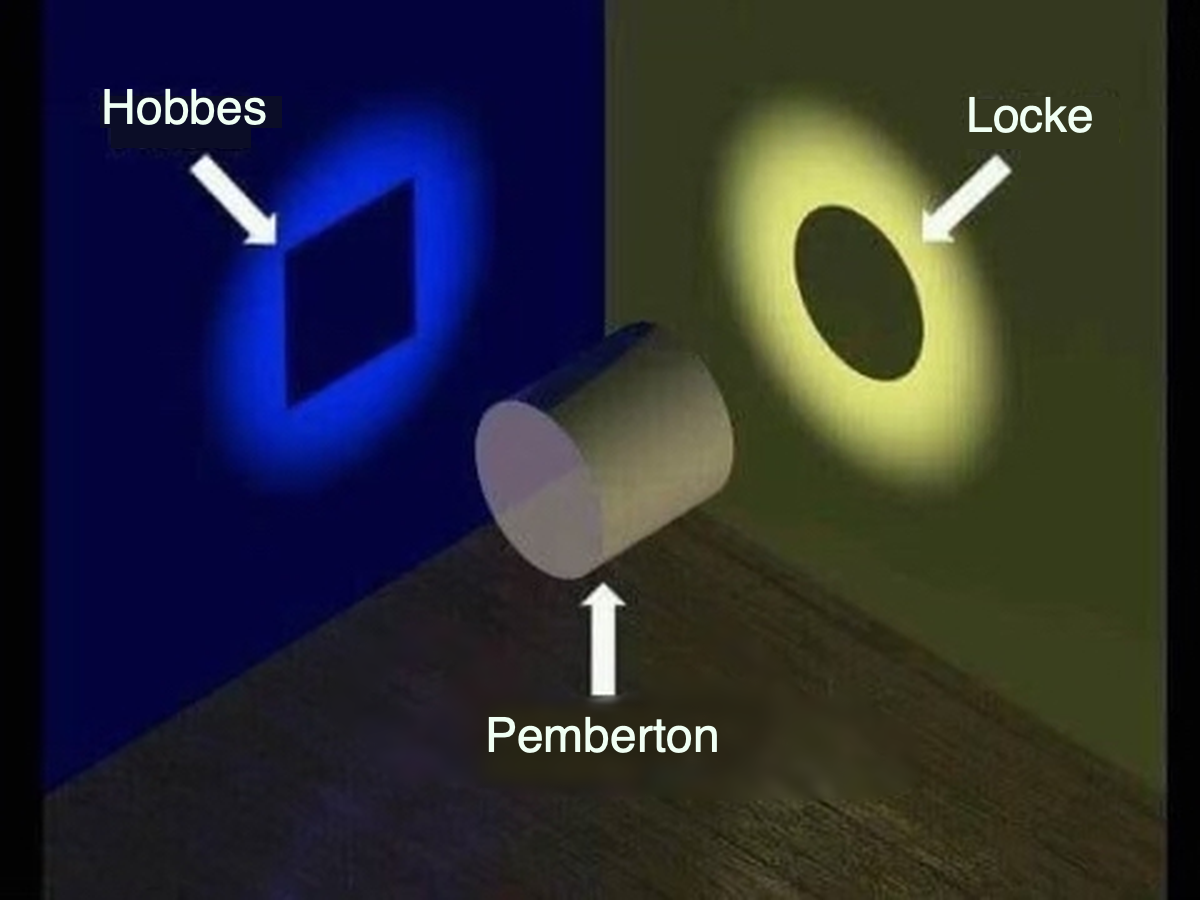
“The RIGHT OF NATURE, which Writers commonly call Jus Naturale, is the Liberty each man hath, to use his own power, as he will himself, for the preservation of his own Nature; that is to say, of his own Life; and consequently, of doing any thing, which in his own Judgment, and Reason, he shall conceive to be the aptest means thereunto.” Thomas Hobbes, Leviathan (1651), Part I, Chapter XIV [Emphasis mine]
This attachment of rights to power shows that Hobbes was also very close to the Temporal Rights paradigm.
All the political philosophers who wrote about natural rights were focused on the natural rights of people only. That limitation is understandable. It is similarly understandable that the universe was once thought to revolve around the Earth. A revised, broader view eventually put a man on the moon. Likewise, the restriction of rights to humans, or at least to sentient creatures, has kept us all from the more universal truth, viz., all things have universal, natural rights. I have named them Temporal Rights, meaning universal, secular, natural rights.
Universal Rights Empower Natural Law
Let me ask these rhetorical questions: Does a beaver have the right to cut down trees? Does a tree have the right to mine the soil and split the rocks? Does a rock have a property right to the space it occupies?
The beaver’s right to cut down trees gives him the necessary authority to continue his existence. This observation can be repeated in every living thing, including trees and men. These natural rights, this natural authority, taken as a whole, empower the whole book of natural law. It is well worth noting that this connection between natural rights and natural law, can be turned around, observed from the other end, and seen to be equally correct: natural law empowers natural objects with the natural rights they exhibit. By extension, looking at all of nature, we see that –
Every natural object has natural rights.
That being the case, it is not surprising that Locke (and everyone else, including ourselves) missed this because natural rights are profoundly ubiquitous, and like a fish doesn’t know it is wet, we have missed what was in plain sight everywhere we looked.
What This Means
This is a breakthrough. This means that John Locke cannot be dismissed because he appealed to God and logic for the source of natural rights.
Jefferson said that these rights were inalienable and this discovery makes them even more so. A novel example: if a rock has a property right in the space it occupies, that right is profoundly inalienable because you cannot violate that right without violating the rock. Existence and the right to exist are but two facets of the same entity. The same can be said for human natural rights: you cannot violate those rights without violating the human.
This inalienability is sorely needed in today’s nihilistic world.
Now, I have been working on this new basis of natural rights for some time, trying in my spare time to plumb its depths and to comprehend its implications. The following paragraphs are the major bullet points that I have discovered so far. This is an entirely new paradigm, like discovering that the earth is not the center of the universe.
What is a Right Anyway?
The idea of “rights” is clearly one of authority. Even toddlers demonstrate this sense when you violate their authority and take away their toy. Then there’s that feeling we all experience, and youths verbalize it with “You aren’t the boss of me.” The idea of “a right” to do or have something is an abstract one, but natural rights are always connected intimately to something physical or mental.
It is insightful to take the perspective of an outsider watching a rights-holder. What we see is someone who has a warrant, an authorization, an empowerment, or an authority to act for, or to be an agent for himself. In other words, having the power (capability) to act is also having the power (authority) to act. The two characteristics cannot be separated. Let me simplify this.
Ontologically: the nature of nature is such that natural things have agency within themselves to do what they naturally do.
We know that objects have natural rights because we see them exerting that authority over themselves and other objects.
It troubles me that these explications complicate something so profoundly simple. Try to stop thinking with words and just ponder a moment on these visualizations where you will see authority and capability simultaneously:
the sun holding the Earth in orbit,
a beaver cutting down a tree,
a child solving a puzzle.
When we view the universe through this quiet lens, we have a spiritual experience. The universe becomes a living thing with beauty, majesty, and power, controlled by the natural laws whose authority is manifested in the rights of its components. [Author’s Note: This is treated in depth in “Universal Unification Under the Lights of Temporal Rights“.]
This is Important
This perspective on natural rights has such profound implications for our governance, jurisprudence, and morality that it needs to be solidly established; grounded so thoroughly as to leave no excuse for its dismissal.
Western civilization rotates on an axis of natural rights. This becomes apparent if one removes the idea from our culture and watches what happens. Freedom and justice disappear and chaos rules. Chaos rules in pockets of our civilization where rights are deliberately violated to create uncertainty and fear as a means to control the vulnerable human spirit.
An improved understanding of natural rights can provide a stronger, irrefutable claim to the sanctity of natural rights and stop bad actors who ride fear into power. This new vision of natural rights appears as a purely secular definition and is therefore incapable of dismissal based on religious belief. Meanwhile, it is not a negation of Divine Providence, but for the believer it is an explanation of how the Creator endowed natural rights.
The Universal Definition of Natural, Temporal Rights
Natural Rights: the authority of operators to operate.
The right to life, or more broadly, the right to exist, creates a space filled by the right to operate.
Because a right is an abstract idea, it must have a real antecedent, or else it has no standing. Its antecedent is the authority exhibited by an entity when it exercises power, capacity, or capability. That statement may seem circular, but only because Temporal Rights are profoundly inherent and intrinsic. One can, with semantic grace, denote a right as being the “authority” aspect of the corresponding capability.
The Semantics of Natural Rights
This definition of natural rights has definite semantic aspects; some may say “definite issues”. To understand the universe, we must be careful of this challenge. For example, we have a choice as to whether we ascribe the idea of rights/authority to the powers displayed. But the more important issue is the working of the perceptor of these things – the human mind. (John Locke would approve of this analysis because he understood the importance of understanding the mind while understanding reality.)
When I leave the world of words, those symbols that are supposed to represent reality, and use my imagination to visualize the workings of the universe, I see actions, reactions, and what seems like the pursuit of goals by rather primitive operators. Then I try to verbalize these observations, and I recognize that the switch from visualization to verbalization poses a clear impediment to comprehension. Immediate voids are applied to the visualization while attempting verbalization because words force pigeonholing. And the pigeon holes do a significantly poor job of representing the reality that I just saw. This explains Einstein’s statement that he never discovered anything by rational thinking.
The idea that the powers of the operators of the universe have authority to use those powers can be seen as a semantic adventure. In the absence of this attribution of authority to power, the idea of natural rights based on that attributed authority collapses. The problem here is with the pigeonholes. Our comprehension of these things is profoundly affected by the meanings of the words we are using, and we find ourselves frustrated in trying to express observations that our language does not permit. This frustration proves the inadequacy of words to convey reality.
If we choose not to attribute authority to these operators, we strip them of their official, authoritative positions and relegate them, and ourselves, to cold, lifeless, entities battling out our meaningless places in the universe. All operators become only causes and effects. But there is a problem here.
This view demands that the human will and the power to choose, the ability we all recognize as a reality of our lives, in fact, the most important aspect of our lives, this denial of conscience and judgment and choice flies in the face of our everyday experience. We know we have choices because we make them constantly, and the sense that we can exercise our willpower in the choosing is in many ways the essence of our lives. Those choices are prima facie evidence of our authority to be agents for ourselves. That fact cannot be reconciled with the idea that we are only physical causes and effects in a meaningless universe. This seems to establish our natural authority we call rights.
If we then admit to this authority, this right to direct our own lives, we have opened the door to seeing that all operators have authority to operate – thus the basis for natural rights is firmly founded and the authority that empowers natural law is identified. There will be a tendency to limit natural rights to sentient operators, but that is an arbitrary choice, for there is no clear demarcation between what we call living and non-living things – between those two pigeon holes.
The claim to rights is universal and is observable at a very early age. Take a favorite toy from a toddler, and he will communicate with his limited vocabulary that he has a right to that toy and his rights have been violated. If we are going to claim any kind of rights for ourselves, then we have already ascribed to the existence of rights, and the attachment of rights to the operators of the universe is justified. From a strictly practical standpoint, this attribution of rights to animals, plants, and all the lesser things provides a solid basis for respect and a kind of reverence for all things: air, water, animals, plants, even the soil, to say nothing of fellow humans.
Finally, this excursion into the semantics of natural rights needs to recognize that all theories of natural rights include the choice to attribute rights to things. Locke, Bentham, and all the others made the decision to perceive natural rights either explicitly of tacitly in their subjects, regardless of their proposed origin of those rights.
Natural Law and Natural Rights
This relationship warrants further investigation. The authority denoted as “law” in the expression “natural law” is based, I believe, on the constancy of relationships found in physics where these relationships have largely been identified and encoded as equations which in turn denote a reliability and predictability. So the idea that natural law derives its authority from the natural rights of the entities of the universe can seem an overreach. However, as we watch these entities interact and see their relationships with one another, we observe their rights in operation with the same authority of constancy. This cements the fact that natural law obtains its authority from the individual natural rights of operators.
Why “Temporal Rights”
I use the name “Temporal Rights”, primarily because they are secular, but also because they arise in the instant of the creation of an operator and are extinguished in the moment of its demise.
The Abstraction We Call Freedom is not an Abstraction
The punishable abuse of rights is the essence of good government, and Temporal Rights clarifies these matters, making them comprehensible, more tangible, and hence more enforceable.
Liberty and justice provide an environment where citizens have confidence in the efficacy of the sacrifices required by progress. Temporal Rights theory did not create this relationship, but it does anchor it directly in natural law. The advantage offered is that once a citizen recognizes its simplicity and power, he will be compelled to honor and/or submit to its civilizing effects. The effect is a direct support to the ideals of liberty and free enterprise, not available under previous theories of natural rights.
Freedom describes a state in which operators operate with impunity because their natural rights are directly and intimately tied to their owners which are palpable objects. Under this light, we see individual citizens exercising their rights. Communism and socialism, for example, are based on group think, or the idea that groups have rights. However, a group is an abstraction and abstractions are always at least one step away from their antecedents.
An abstraction cannot possess a Temporal Right.
Good and Evil
The Temporal Rights paradigm leads to the principle that good is honoring, respecting, and protecting natural rights, and evil is any violation of those rights, whether by law or person. Can you think of an evil that is not such a violation? This morality is powerful because it is simple. And it forms a basis for justice and jurisprudence.
Because the exercise of one’s natural rights usually violates the Temporal Rights of other operators, this exercise creates the obligations that justice requires. When a chicken’s life is terminated so I can eat, I am in debt for that life taken, otherwise, I live by theft or extortion. This is another powerful connection between Temporal RIghts and morality.
A Paradigm Shift for Jurisprudence
The usual view of crime sets a perpetrator against a victim, but under the light of Temporal RIghts all conlicts are seen as a conflict of rights. This is a paradigmatic shift that balances the process of jurisprudence by simultaneously recognizing the natural rights of both parties. Temporal Rights establishes an objective view rather than a prescriptive view of crime.
Jurisprudence cannot be even-handed while crudely casting conflict in the simplistic framework of perpetrator/victim. Meanwhile, justice demands an understanding of the hierarchy of these rights. Even a stone has the right to the property (space) it occupies, for if that is denied, there can be no stone. So a spectrum appears, or a hierarchy of rights, with the least rights belonging to a minuscule grain of clay and the greatest to the gods, who, being all-powerful, must have superior rights in all categories.
Realizing that natural rights have a natural hierarchy, I have begun a search for a way to place them in their proper order. I have discovered a method that needs much work but seems promising. It is described in Boundaries of the Temporal Rights Hierarchy. These can be used in jurisprudence as an aid in balancing the rights of the plaintiff and the defendant because they demonstrate types of rights and their relative weights.
Overcoming Nihilism
The “scientific” thinkers have all but conquered our civilization and are hell-bent on returning us to the pagan state the desert religions saved us from. They happily celebrate the death of God with their hedonism and perversions that, for example, are sacrificing children to the god of convenience and to sexual slavery they call freedom. They don’t seem to realize that they are fundamentally claiming to be the center of the moral universe.
The Temporal Rights perspective offers a completely secular origin for the natural rights that they cannot dismiss as religious.
The Temporal Rights concept goes even further. If the highest power of man is the ability to choose, then the highest choice must be the choice to love.
The Spiritual Component of Temporal Rights
When the Native American saw a buffalo, he saw two things simultaneously: a spiritual creature and a resource of meat, bone, and hide. Many of these people thought it was necessary to explain to the animal what was going to happen and why. Some even thought that unless this kind of respect was afforded to an animal or plant, the power and/or healing/nourishment would not be realized.
Perhaps our pioneer heritage explains how we adopted the “conquering the West” attitude. Civilization washed westward in a great wave where survival was paramount, and the elements of nature were always a challenge. This simplistic animosity separated and characterized us as enemies, facilitating our materialism.
Yet, we are repulsed at our extortion of eggs from caged hens, but have not been able to articulate clearly the reason why. Temporal Rights reveals a unified picture where all things, especially living things, are cousins. It is not “us against them” but “we are all family”: creatures not with opposing characteristics but whose differences are only of scope and degree. This unity is seen, oddly enough, in the conflict of rights that literally “makes the world go round”. Progress requires that superior operators exercise rights that violate the rights of lesser operators. This is an area that needs work. See the working paper, Boundaries in the Natural Rights Hierarchy.