

Natural Rights
For centuries, philosophers have struggled to ground human rights on an indisputable basis, a basis that could only be found in naked reality. They came close with appeals to nature, the laws of nature, the natural abilities of the human being, but for a link to nature, their theories always required reason. A paradigm shift demonstrates that they were on track: the indisputable basis is found one more level down.
Their theories were predominantly theistic or metaphysical, relying on divine authority, innate human dignity, or natural law. John Locke came close when he said, “The state of nature has a law of nature to govern it, which obliges every one: and reason, which is that law, teaches all mankind, who will but consult it, that being all equal and independent, no one ought to harm another in his life, health, liberty, or possessions.” Second Treatise of Government, Chapter II On the State of Nature, §6
Thomas Hobbes also approached an intrinsic basis with this: “A [natural] right of nature is the liberty each man hath to use his own power, as he will himself, for the preservation of his own nature—that is to say, of his own life—and consequently of doing anything which, in his own judgment and reason, he shall conceive to be the aptest means thereunto.” Leviathan, Chapter XIV Of the First and Second Natural Laws, and of Contracts
Both men appealed to the natural world, existence, to anchor their demonstrations of natural rights. They could feel that rights were a person’s authority to exercise their powers and recognized that freedom to do so was a required circumstance. Had they not confined their search to human rights, they likely would have made the step into intrinsicality.
Morality
For centuries, philosophers have struggled to ground morality on an indisputable basis. The most notable theorists were Aquinas, Kant, Bentham, and Mill. These men found it in God’s will, reason, utility, and happiness. But down through the years, none of these has proven satisfactory. Each one failed to provide a basis that could be universally recognized.
Normative ethics has been based on utilitarianism, deontology (duty), and virtue, but none of these has found broad acceptance. There was always a better cluster of utilities, duties, and virtues. Normative morality also was also beset by the “ought” side of Hume’s guillotine.
Prescriptive ethics has its own troubles with ongoing debates about which prescription is best. To make matters worse, there is the nagging problem of empowering any of the offered prescriptions to bind behavior because the prescriptions are statements only of what ought to be – the “is” side of Hume’s famous cleaver.
Such was the state of affairs as we enter our Semiquincentennial year. Natural rights are dismissed for their basis in divine authority, and immorality is rampant, demanding more stringent laws that erode freedom and grant more and more control to a government that itself needs to be better controlled. But there is hope.
Existence, Natural Rights and Morality
Their writings prove they were looking into nature for natural rights in humans. Let’s suppose that natural rights are found in all the agents in nature. What then?
Beavers are much like humans in their lifestyle, gender roles, etc. They are also monogamous, in case that matters. Watching a beaver cut down a tree is both a moral and an authoritative event. The beaver is using its existential authority to fell a tree. We are seeing a beaver using its natural rights to violate the tree because that is in the “food chain” that supports its existence. And in the process, it is killing a tree. It’s that simple, and that profound. There, at the existential, naked level of reality, we find the demonstration of rights and moral agency. “Reason” was the link needed to connect Locke and Hobbes to nature. This perspective takes reason out of the linking function and places it where it belongs: understanding what we are witnessing.
These ethics are not inferred but demonstrated: the exercise of rights (authority intrinsic to an entity’s capabilities) inherently constrains the exercise of authority by other entities that happen to be in the same domain. This should not be misconstrued as a war between operators. It is no more a war than the reciprocal flows of waste and nutrients across the membrane separating a blood vessel from a cell, where interaction, limitation, and dependence are the structure of life itself.
Semantics
We are not accustomed to seeing natural rights in non-human agents, but what criteria can be cited to prevent it? Do the natural rights and moral universes rotate around the human being? When we watch a beaver make a lodge for its family and a dam to flood its basement entrances, we see a free agent/operator using its existential dominion, power, agency, prerogative, license, permission, and authority. We can deny that it demonstrates a natural right, but denying it will not stop the beaver from using its capabilities. Semantics can get in the way, but words don’t matter here. What matters is what is obviously and objectively happening. Confessing that these are rights in motion helps us see and feel the weight of the ethical transactions.
It is enlightening to see that the beaver’s activities demonstrate its capabilities, so there is a one-to-one relationship between capabilities and natural rights. This is not only reasonable but intuitive because it makes no sense to say, for example, that a person has a right to jump over his house. He can’t do it, so the right to do it is nonsensical.
The Natural Hierarchy
It is important to note again that the beaver was inflicting terminal damage to the tree which makes that a moral event. By extension, we find that the popular concept of a food chain is also a morality chain where humans are omnivores, eating both animals and plants, whose lives are extinguished in the process. This food chain reveals a natural hierarchy of operators. Apparently, nature is demonstrating that higher orders of agents have rights superior to those of lower orders. The breathing animals consume plants, and plants consume sunlight and soil, and trees split rocks, and rocks defend their property rights.
Here we can also mistakenly cast this as a war for existence, or we can cast it as the balance of nature, or, more fundamentally, as the universal ascendency of operators through ordered dependency, wherein each operator’s authority is exercised within, and limited by, the prior conditions that make its operation possible. (For example, have those operators spared the freedom to act?) Those conditions were determined earlier by the operations of other operators in the same domain, thus forming a continuous moral structure where no operator’s rights can be justly evaluated in isolation, much as reciprocal flows across a membrane sustain the life of both cell and organism.
We might have expected these relationships because existence often appears to depend on opposition; yet what sustains existence is ordered dependency among operators. Even at the atomic level, stability does not arise from opposition but from the constraint of permissible states, illustrating that existence is sustained by ordered dependency rather than conflict.
The “food chain” was an analogy to support the realization of ethics; the fundamental, and more relevant, hierarchy is shown in the following short dependency stack. Each level is inherently dependent on the level below it for its existence. If capabilities vanish, authority and moral events also vanish.
- Morality (intrinsic in authority)
- Authority (intrinsic in capabilties)
- Capabilities (intrinsic in operators)
- Operators’ existence
Consequences
So we have come full circle. Surely, Hobbes and Locke would have seen this if their goal had not been restricted to human natural rights. Like theorists before Galileo, who assumed that the astronomical universe rotated around the earth, their perspective inherently set a false dichotomy between people and beavers.
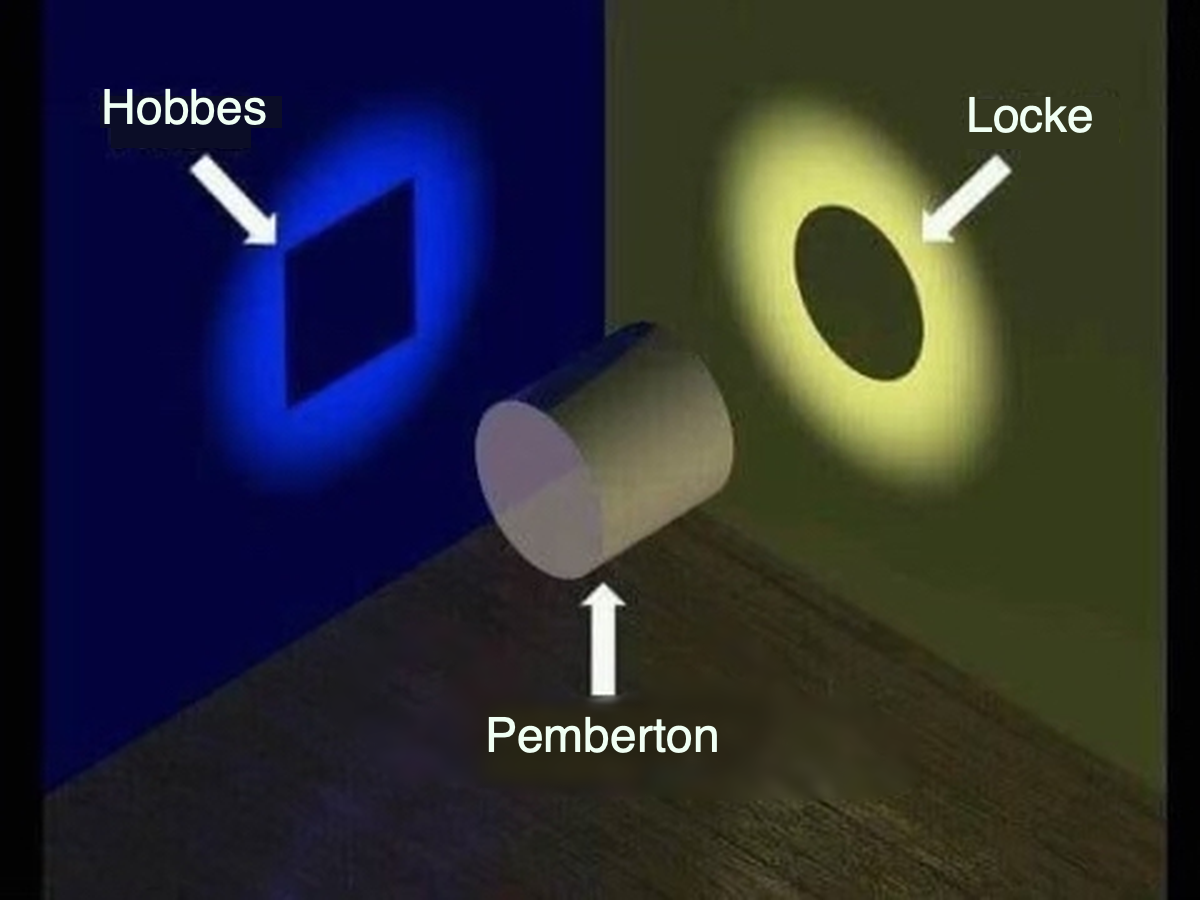
This basis for natural rights also dissolves the “is-ought” dichotomy, showing them to be the artifact of separating ethics from fundamental reality. This is not a rebuttal of Hume, but a category error correction. A similar categorical correction is seen in the animal vs. human rights sphere, showing them to differ only in scale, not type.
This is a state change. Natural rights are grounded in naked reality, with the consequence that morality is evident everywhere. We shall see that these two existentially grounded principles change everything above them.*
Individual Freedom
The Temporal Rights view of nature inherently enshrines freedom as that necessary condition that permits operators in general and citizens in particular, to exercise their natural rights, their abilities, their hopes and dreams, and to strive therewith to pursue happiness as it shall appear to them most promising. These rights show that literally nothing is demanded or required of other operators but only their respect for one another’s boundaries.
When our Constitution came into effect, and people had confidence in their autonomy and property rights, investment reached new heights: investments in self, family, land, tools, arts, research, and development. That ushered in a great period of prosperity and advancement. It was a glorious period (except for the slavery culture that lingered on and on). Now, as big government has become a giant operator with intrinsic goals to expand and acquire, and with operations that increasingly violate the natural rights of its citizens, the need for that government to respect those boundaries is urgent. As citizens, we must operate in our remaining freedom in such a way as to leverage our rights to domesticate the wild animal it has become. We have the existential agency and the existentially grounded rights to both demand and acquire that freedom. But we must put our passion first in liberty rather than in short-sighted social empathy that distracts us from the only sustainable solution. That doesn’t require meanness or lack of empathy for one another; on the contrary, let us love our neighbor and our country. After all, love is the greatest force in the universe because it never forces anything.
A Celebration
Such is the state of affairs as we enter our Semiquincentennial year. Life, Liberty, and the Pursuit of Happiness are demonstrated in the fabric of the universe. Locke’s rights cannot be dismissed for being based on a religious tenet, the morality demanded by those irrefutable rights is established in the nature of nature, and “all nature sings, and round [us] rings the music of the spheres”.
“Let music swell the breeze,
And ring from all the trees,
Sweet freedom’s song:
Let mortal tongues awake;
Let all that breathe partake;
Let rocks their silence break,
The sound prolong.” **
* The existential grounding of natural rights and morality employed in the present paper is extended formally in Jackson Pemberton, “An Existential AI Morality” and in forthcoming articles “A Unification Theory: Universal Natural Rights,” and “Entropy: the Physics of Natural Rights and Ethics” SSRN (2026).
** Katherine Lee Bates’s poem, “America”, fifth verse, usually dropped from the song “America the Beautiful”.