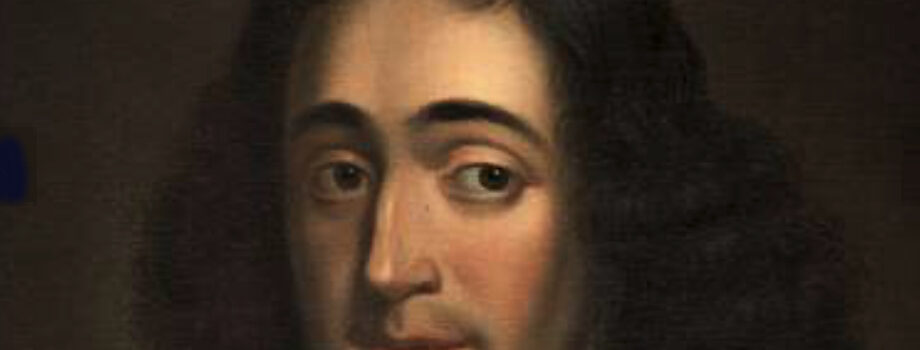


A kind professor at Hillsdale College recently pointed out that Spinoza’s perspective on natural rights was closer than John Locke’s to the Temporal Rights paradigm I discovered fifty years ago this month. I have often thought during the interim that someone else must have made the same discovery. That is a typical scenario: the body of knowledge expands to the doorstep of a new insight and multiple people recognize it.
This article represents a correction of my earlier claims that the Temporal Rights paradigm is an unprecedented grounding of natural rights, because that is not entirely correct.
How Beruch Spinoza Saw Natural Rights
He writes in his Theological-Political Treatise and Political Treatise that “Each thing has as much right as it has power to exist and act.” This is a description of my beaver felling a tree, and a description of the law of the jungle. It is the idea that a capability existentially and intrinsically demonstrates the natural right to exercise it.
However, where the Temporal Rights vocabulary uses “Operator”, a descriptive noun, as a label for an entity or agent, Spinoza uses the Latin “conatus”, which translates to “effort, endeavor, struggle, or undertaking”. These are gerunds, which means he recognized rights belong to the actions of things rather than the things themselves. This comports well with the Temporal Rights vocabulary, where a capability and a right are two exhibitions of the same thing, but the somewhat subtle difference remains.
The correspondence so far is virtually perfect.
How Temporal Rights and Spinoza’s Rights Differ
While Spinoza seems to detach ethics from natural rights, my beaver is killing the tree. Thus, Temporal Rights recognizes that when Operator A uses a capability to restrict or prevent the use of Operator B’s capability, a moral event has occurred. By extension, this can define evil as a violation of natural rights. Indeed, it is difficult to imagine an evil that is not such a violation. This attribution of morality to the exercise of rights becomes a central issue as soon as the Dependency Stack is constructed. That stack is a series of dependency statements of the form exemplified by:
An operator can act without acquiring, but it cannot acquire without acting.
This shows the ascendency of acquiring over acting and the dependency of acquiring upon acting. The Stack is an interlocking group of statements of this type, forming a continuous spectrum of rights and capabilities. The Dependency Stack also implies or infers the ascendency of natural operators in harmony with their inherent complexity. This invites entropy as an alternate vocabulary for natural rights comprehension. The Stack reveals rights stretching from existence to the realization of the full utilization of all the capabilities of an Operator.
Finally, while the Dependency Stack demonstrates rights violations as moral events, recognizes the rights of both operators involved in a moral event, and hints at the intensity of moral infractions, it also points to how operators can collude in the elevation of operators toward fulfillment of their highest development.
Are there enough differences between Spinoza and Pemberton to warrant the “unprecedented” label? Maybe, maybe not. It really isn’t an important issue, not nearly so important as the need for citizens to recognize that our natural rights were endowed by our Creator in an existential, baked-into-the-universe manner and cannot therefore be violated without adjudicatable moral consequences that not only violate legislation but the very laws of nature. “Don’t mess with Mother Nature!”