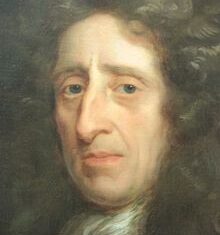


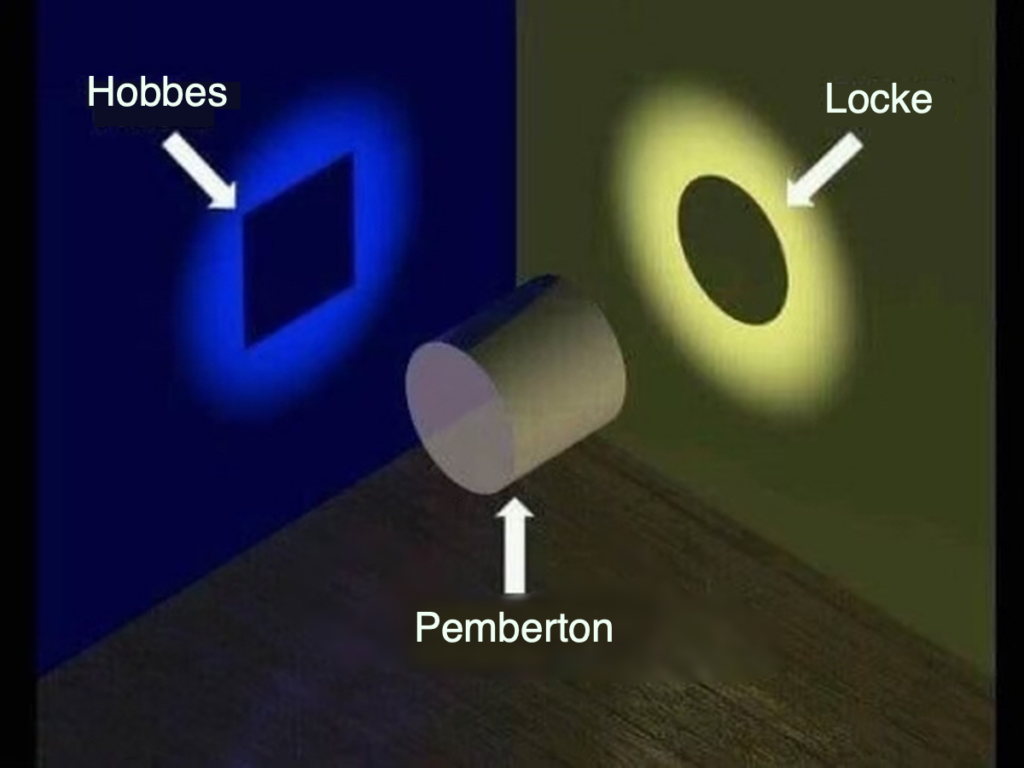
This paper presents the core concepts and most interesting features of this powerful, unique, and unprecedented basis for John Locke’s natural rights. They effectively prove that Locke was right. I identify these with John Locke first because these natural rights are the rights he saw that gave us life, liberty, and property in the Declaration of Independence. When you read a summary of Thomas Hobbes’ theory of rights, you see that he was close to seeing Pemberton’s view. Both Locke and Hobbes assumed that rights belonged exclusively to humans and that would be sufficient to keep them from the whole truth. Temporal Rights not only support Locke’s and Hobbes visions of natural rights, but they also expand, clarify, and ground them. Temporal Rights are universal; you cannot see any activity without seeing the exercise of natural rights. They are profoundly ubiquitous.
These are the rights upon which the greatest (most prosperous, most just, and most free) nation in the world was founded, and which therefore are in most need of protection. This is especially true in the present environment, where many deny the existence of a Creator and others just don’t want natural rights getting in the way of their ambitions. Rights that are not recognized and comprehended cannot be well protected.
Finally, by way of introduction: Operators (see below) have a wide variety of capabilities which suggests a hierarchy – the one we see in nature – the law of the jungle for instance. The essay you are reading together with a existential hierarchy are connected to create an Artificial Intelligence Moral Machine (AIMM) that can instill an objective morality into an AI. I am testing this AIMM today, December 30, 2025.
An Overview of Temporal Rights
The following ideas are couched in universal terminology, but I hope my reader will see their application to the human individual.
The following are one-line titles for sections below in the same order. The blue, underlined headings will take you to their corresponding section.
- Operator
- Authority
- Natural RIght
- Domain
- The Ontology of Temporal Rights
- These natural rights are ubiquitous.
- These natural rights are intrinsic.
- These natural rights are inalienable.
- These natural rights are immutable.
- Life
- Liberty
- Property
- Temporal Rights demonstrate that freedom is fundamental to existence.
- The authority of natural law is the aggregation of opertors’ rights.
- Temporal Rights is secular and immune to dismissal.
- This is how the Creator endowed natural rights into man (and the universe).
- Temporal Rights directly infer a system of ethics and morality.
- Temporal Rights reveals flaws in applied science.
- Jurisprudence: Crime is not properly framed as perpetrator/victim but as a collision of rights.
- The law of the jungle is validated as the description of temporal reality.
- A philosophical unity with Eastern and Native American thought.
- Where justice rules, violations of natural rights create obligations.
- How making covenants can expand an one’s rights.
- The choice to love can lift operators to higher planes of existence.
Definitions, Principles, and Observations
Definitions
Operator: Any self-existent object having capabilities and boundaries: stars, planets, man, beavers, trees, microbes, gametes, rocks, and people. Operators created by other operators are operators in their own right. Abstractions like “society” or “forest” and natural processes like chemical reactions and rivers are not operators in their own right but the operations of lower-level operators in their overlapping domains.
Authority: An operator’s dominion within its domain demonstrates its authority or right to operate. Or, in other words, operators and their operations co-exist, and their observable authority to operate is the existential evidence of their right to operate. We call this authority a natural Temporal Right. This dominion is rarely, if ever, sole and may be totally overpowered by other operators. This does not negate the operator’s authority, only its freedom to exercise its capabilities. Thus, a hierarchy of rights and their operators is the raison d’être of the changing universe.
Natural right: The abstract concept of the authority of an operator to operate. This includes both active and passive capabilities, viz., atoms doing chemical reactions and rocks defending their property rights to the space they occupy.
Domain: This is not an existential part of the operator but a descriptor of its spatial volume of operation and/or its type of operation. A rock’s domain is the space it occupies, while a tree’s domain extends beyond its own body when it gathers sunlight, water, and minerals. The domain of a bird may include a hemisphere, and of a star, an entire galaxy.
Many operators recognize information and adjust their behavior accordingly. These have a physical domain and an informational domain. There are probably other domains yet to be identified.
Principles
The Ontology of Temporal Rights
The essence of the existence of operators is their capabilities/powers to operate. Powers entail a structural authority to operate. This authority is the operator’s inherent title to its operations. To state this another way …

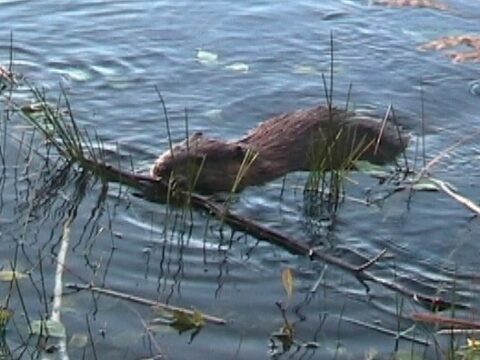
An operator “owns” or has dominion in the sphere within which it operates. It is an agent exercising its authority (dominion or agency) to perform its operations. Such dominion is both necessary and sufficient to its operations and, therefore, an expression of, and evidence of its natural authority or rights. For example, when you watch a beaver cutting down a tree, you see that it possesses and exercises dominion, agency, prerogative, privilege, authority, power, license, permission, and consent. There is no better label for this existential display of agency and authority than “natural rights”.
This is not an arbitrary attribution that attaches authority to capability but an existential and structural fact. If it had no dominion, it could not operate. This is a recognition that the universe is not only filled with operators, but it consists of operators: they are the components of its structure, the bricks and mortar of its being. The tree and beaver scene is filled with thousands of operators. The beaver operator consists of millions of nested operators, its eye, the lens, the cells, the proteins, the molecules, etc. And then there is the tree and its complexity.

You may reject the vocabulary of “authority” or “right,” but you cannot reject the underlying structure without rejecting the capability itself. The existence of a capability gives the operator agency, actionable power that defines its essence. You may even say that the whole idea of rights is an abstraction, and that is correct; we abstract a right from its corresponding power. But it is an abstraction only to the extent that it is a description of a reality and not the reality itself. It is therefore an appropriate label for an existential reality.
Sole dominions are probably non-existent. Operators exist in a swarm of overlapping domains, and that is what makes all processes in the universe possible. If domains did not overlap, there would be neither change nor progress.
These Natural rights are ubiquitous.
Revisiting the tree and the beaver scene, we see that there are almost an infinite number of operators, each one exercising its rights and capabilities, restraining and assisting other operators. The beaver, an intelligent creature, is killing the tree to build a dam or a lodge to support its family. Earth’s gravity is authoritatively pulling down the chips whose materials the tree, also an intelligent creature, once “knew” how to lift into place, etc. The tree’s intelligence is a “computer program and procedures list” embedded in the seed that gave it life. These insights show the earth and all its operators as intelligent agents exercising their natural rights in an awesome, lively dance celebrating their existence.
These natural rights are profoundly intrinsic.
Each operator has sufficient dominion in its domain (sphere of influence) to allow its operation. If it somehow lacks the capability or power to do a particular operation, then it lacks sufficient dominion. (We are focused on the fundamental structure of the operator, not the clipped dominion of an operator being overwhelmed by another operator.) This dominion, therefore, defines the extent of the authority or power of the operator while recognizing that this authority may be oppressed.
Words can corrupt understanding by inserting pigeon holes into the process of comprehension. We can unknowingly and falsely categorize or limit the truth of an observation simply by trying to put it into words. Our minds are most comfortable if they can put things in familiar pigeon holes. In the present discussion, if we stop using crude word tools and just visualize an operator exercising its powers, we see authoritative dominion in action. We can then draw out the abstract fact of rights from that observed authority. Watch the sun hold the earth in orbit, and the earth hold the moon. Thus, a capability and its corresponding right are but two semantic labels for the same property.
This intrinsicality cannot be surpassed.
These natural rights are profoundly inalienable.
The property right of a stone to the space it occupies can only be violated by violating the stone itself. But then it is not a stone anymore, but two stones, each with its own property right. This principle is found to reign with every operator. It is impossible to change the rights of an operator without altering the operator’s capabilities which are the essence of the operator and the definition or description of its being.
This inalienability cannot be surpassed.
These natural rights are profoundly immutable.
The exercise of operations or capabilities may be completely frustrated, but the latent capability and its corresponding right remain. If an operator is damaged sufficiently to alter its capabilities, it is no longer the same operator.
This immutability cannot be surpassed.
Life
The right to life is an existential fact of the existence of living things.
Liberty
The right to freedom is the existential right to exercise one’s capabilities.
Property
A tree gathers sunlight, water, and minerals from the soil. This is its domain of operation. It cannot be a tree unless it can acquire and use things outside itself. The right to a domain of operation is a necessary part of the right to exist. All living things possess this property right. A person’s right to gather, protect, maintain, and use property is their right to their domain, without which their humanity is violated, and their existence is compromised.
(I cannot but note with satisfaction that this property right is only tenable when supported by logic, as John Locke explained. In his Second Treatise, §6, we read: “The state of nature has a law of nature to govern it, which obliges every one: and reason, which is that law, …”)
Observations
Temporal Rights demonstrate that freedom is fundamental to existence.
The Temporal Rights framework derives rights solely from capabilities and their operations, and therefore not from needed states or circumstances. Freedom to operate is a description of a state, not an operation.
Therefore, under Temporal Rights, freedom is defined as the absence of interference with what an operator is able to do. It is grounded in the operator’s capabilities, applies only where those capabilities are actually obstructed, and does not require any other operator to use its capabilities or resources—even in difficult cases, including the restriction of artificial intelligence systems. This is not a positive right; it requires no provision, only acknowledgment of the boundary.
This relationship between operators is in harmony with the principle that evil consists of interference by an operator’s powers into the domain of another operator, which makes it a candidate for AI morality.
This describes the condition of a perfect government, one in which all citizens refrain from infringing on the rights of fellow citizens. Because not all citizens do so, government is compelled, for the sake of freedom, to constrain rights violations by deterrence or force. To whatever degree a citizen’s freedom to operate is interfered with, to that degree he is at best oppressed and at worst enslaved.
The authority of natural law is the aggregation of operators’ rights.
This is self-evident upon recognition that a domain and the right to operate therein are coincidental. It is the operations of natural operators that authorize and empower natural law. Thus, it is the nature of nature that empowers natural law.
Temporal Rights is secular and immune to dismissal.
Temporal Rights are not based on religion, political expediency, social relations, moral obligations, traditions, customs, cultural norms, or any basis other than the realities of existence. No appeal needs to be made to divine authority or divine endowment. This makes John Locke’s natural rights immune to dismissal because “They are granted by a non-existent God.”
Temporal Rights also avoids the classic “positive-rights” objection. Unlike need-based entitlements, which implicitly encumber other operators by requiring them to provide or fulfill those needs, Temporal Rights are purely negative. They arise solely from the operator’s own existential capabilities and structural authority, imposing duties only of non-interference on others. Please note that this also describes freedom.
This is how the Creator endowed natural rights to man (and the universe).
An explication of the temporal rights view of natural rights is a description of how the Creator baked rights into the very structure of objects with profound intrinsicality and profound inalienability. But only a believer will recognize this fact. The non-believer will be blind to that relationship.
Temporal Rights directly imply a system of ethics and morality.
This new theory of natural rights demonstrates that evil is the violation of natural rights. It may be impossible to identify an evil that is not such a violation. “Good,” on the other hand, is clearly the exercise of these rights in a way that recognizes and protects the rights of other operators. This is a codification of: operate on others as you would have them operate on you. It is therefore the recognition, preservation, and expansion of natural rights. These simple facts form the basis of morality and a powerful AI ethics without blinding it.
Can you think of an evil that is not the violation of a right?
The Temporal Rights paradigm also avoids David Hume’s ‘is-ought’ problem. It does not deduce prescriptive moral imperatives (the “ought”) from descriptive facts about existence and capabilities (the “is”). Instead, the moral principle—that violation of these intrinsic authorities constitutes evil—is stipulated as an axiom that defines the framework itself. Once the concepts of operator, capability, and that capability’s structural authority are accepted, the identification of violation with evil becomes analytic, not a synthetic leap that would require an external, normative premise.
This is why an AI morality can be deduced from the nature of nature. This mirality doesn’t depend on a synthesis of other, outside phenomena, but stands alone on it’s own natural feet, founded directly on the laws of nature.
Temporal Rights reveals flaws in applied science.
Many taxonomies have conflated abstract categories with existential ones. This produces a confused perspective on their subject. This is particularly true in the biological and social sciences. Temporal Rights demonstrates how to detect abstract categories so they can be replaced with self-existent ones.
Jurisprudence: Crime is not properly framed as perpetrator/victim but as a collision of rights.
Jurisprudence will never be even-handed until crime is cast correctly as a collision of rights. The perpetrator/victim paradigm has the unfortunate tendency to ignore the rights of the perpetrator, whose rights are frequently violated in a way that at least unnecessarily tempts him or aggravates him to commit the crime.
The law of the jungle is validated as the description of temporal reality.
The law of the jungle is displayed where operators wield their powers to the detriment of other operators. This law is played out in the Serengeti savanna and the back alleys of cities. This means the Temporal Rights perspective produces an honest view of life as it plays out in this temporal world. As we learn to recognize and take accountability for this, we may raise ourselves to a new level of honorable and peaceful existence. This will happen as fast as we learn to exercise the freedom to choose to love as opposed to the freedom to use. This must apply to fellow beings and our environment.
Western thought is dominated by the idea that things are made to be used, and those “things” are too often people. Those who fail to recognize that the exercise of rights entails obligations operate without honor, without moral constraint, and without love.
But there is an interesting characteristic of Temporal Rights in that it recognizes the law of the jungle as a correct model of the way operators wield their rights/capabilities in their domains in the present world. It permits us to see rights correctly and to address their conflicts with integrity. This can be done using a hierarchy of rights that is laid out in Boundaries in the Temporal Rights Hierarchy. Here, the ascendency of rights shows us which rights are superior so that when a collision occurs, jurisprudence has a guide, based on actual operating observations, with which to resolve those conflicts.
In the process of discovering and articulating that hierarchy, I noticed that the hierarchy for humans is significantly taller than for other living creatures. This is to be expected because we have a much broader spectrum of powers. While addressing that fact, I could not help but think about the line we try to draw between living and non-living operators. It always seems arbitrary when we get down to the last few choices. Then I realized that living is just operating capacities, and suddenly the universe came alive as I realized that living, for all creatures, is the same as operating. And so, by extension, all things came alive. That’s why I keep feeling that the universe is alive; a living, changing, evolving wonder. And this sounds like the Eastern and Native American way of thinking.
A philosophical unity with Eastern and Native American thought.
As they now stand, Eastern thought is profoundly different than Western. We see the world as a vast number of separate objects, while they see it as one complex whole. Our fractured view leads us to seek accumulation, while their perspective seeks harmony. Yet, we are repulsed at our extortion of eggs from caged hens, but have not been able to articulate clearly the reason why. Temporal Rights reveals a unified picture where all things, especially living things, are cousins. It is not “us and them” but “we are all family”: creatures not with opposing characteristics but whose differences are only of scope and degree. Temporal Rights help us see that dogs and trees “are people too.”
When the Native American saw a buffalo, he perceived two things at once: a spiritual creature, and a source of meat, bone, and hide. Many of these people believed it was necessary to explain out loud to the animal what was about to happen and why. He recognized he was about to violate the rights of the buffalo.
The West could improve its relationships among citizens, with our environment, and with Eastern and Native American cultures by adopting the Temporal Rights perspective.
Where justice rules, violations of natural rights create obligations.
Seen under the light of moral values, any exercise of a natural right that impinges upon the natural right of another operator creates a debt or obligation to the injured operator. In the preponderance of violations in the universe, we don’t yet observe compensation. This is seen in the food chain of all living things, for they live by the destruction of other living things. But we see no morality in effect there, no attempt at justice, but a hierarchy of natural rights in process.
People with moral values see the creation of a debt or obligation when they violate the natural rights of lesser operators. Unnecessary violations create an even stronger obligation that cries out for justice and/or recompense. Bitches confined in the tiny cages of a “puppy mill” and laying hens in their two cubic feet of space are examples of operators whose natural rights are routinely violated for maximizing profit.
How making covenants can expand an one’s rights.
One of the fascinating characteristics of the Temporal Rights view is that a person can expand their rights by expanding their capabilities. This is done by entering into covenants with others whose capabilities and/or domains are different or larger. Covenants bind operators together and give them both increased reach and power. The marriage covenant is an example of two people with different capabilities binding themselves together in a unification relationship that grants criss cross access to all available powers.
The Apollo Projects were huge and their accomplishments were amazing, but their power rested simply in the individual business relationships (covenants) that combined the capabilities of millions of people.
A covenant is a voluntary restriction of our freedom, but it is a key to greater freedom and power. An agreement is always a promise to live our lives in a certain way. Self-discipline has always been the key to power.
The choice to love can lift operators to higher planes of existence.
Natural rights can be exercised in a way that recognizes the natural rights of other operators, or, in other words, in a way that is in harmony with natural law. This is the engine that drives material progress. But a parallel opportunity appears.
It seems intuitively obvious that the right to choose is the highest natural right of human operators. And the highest choice is to love; to choose to love instead of choosing to use. Such a choice not only honors the rights of others but also leverages both the lover and the “lovee” to a peaceful, harmonious, and all-around beautiful and joyous state. I believe that even the animals respond to this principle. They certainly enjoy the free exercise of their rights/capabilities.
To love is to choose the higher way, the path where the disciplined exercise of natural rights elevates us. Why do politicians, even conservative activists, never use the word “love”? It seems they may be more interested in “using” than loving.
I believe that love is the strongest force in the universe because it never forces anything. This self-constraint frees everyone from physical, intellectual, emotional, or spiritual intervention and demonstrates tolerance, freedom, and safety.